By: Jessica Miller | Hoard’s Dairyman
WINONA, Minn. – Cutting through the static of tempting new apps, the latest hair-splitting research findings, and the allure of around-the-clock data, one Minnesota dairy farmer finds success in knowing his herd and staff — and trusting his gut.
When asked about his plans, Jason Barkeim chuckled, “I’ve got a lot of them.” Whether they pan out, he acknowledged, depends on much more than just his intentions, but this North Star State resident has done the back-of-the-envelope math and set his course. And at Barkeim Farms near Winona, Minn., that has been enough to crack the dairy farming code: Focus on the fundamentals, not the crowd. Then — on balance and come what may — you’ll probably see more successes than failures.
For Barkeim’s 310-head dairy herd, bettering the basics has garnered the farm multiple awards from the Minnesota Department of Agriculture for somatic cell counts (SCC) lower than 100,000. “It never was a specific goal,” Barkeim said of the SCC achievements. “But I’ve found what gets us there is the biggest, most important thing — cow health.”
The primarily Holstein herd’s soundness has been the foundation of the family’s success and longevity, he said; they were earning SCC commendations as early as the 1980s. “I know a lot of people say that SCC numbers are all about the prepping and procedure. But we had one year a long time ago when cows were very healthy and we had poor help — and still, our SCC was down under 100,000.” Building on the health and overall genetic quality of their herd, the Barkeim family turned to resolving the staffing issue. “We eventually were able to hire some good-quality help. They treat the cows so well,” he said. “We hired the guy who turned out to be great, and through some referrals and family, it just snowballed.”
The dedication of the Barkeim workers, in fact, has earned the operation a bit of a reputation. “A nutritionist who farms asked me, kind of hinting around, ‘Where do you get your staff?’” Barkeim recalled. The question underscores the family’s luck in stumbling on such valuable team members.
Spotlight on simplicity
Feeding is another priority at the farm, and here, too, Barkeim believes that common sense comes into play more than paying undue attention to the finer points of research or in-vogue trends. “Give them the ingredients they need, and make sure it’s quality feed. I trust my nutritionist, and my biggest priority is consistency — what he puts down on paper, I follow. If questions arise, I’ll discuss it with him, and we’ll make adjustments.” Communication is part of his fundamental rule for farming: Filter out the interference, and follow through.
“I know a lot of people who, when the milk price drops, will say ‘Well, we’ve got to cut back somewhere,’ and they’ll cut back on feed. But if you do that, because if you’re losing dollars already in your milk, you’re then also losing if you’re not giving the cows what they need to keep production up — and then you’re doubling your loss,” Barkeim said. “Looking at cost and payoff doesn’t always have to be a matter of sitting down with calculators and formulas.
Sometimes, he asserted, you have to trust your gut and just move. “I put in new fans this year because our big center aisle fans were failing. I’d been considering getting new ones, and last year, I didn’t even sit down and figure out if I could afford them; I just said, ‘I have to do this.’” He reconfigured the setup to provide air circulation where the cows would normally lie; they’d been bunching by the still-functioning center aisle fans. Then he waited for two things: 1) the cows to change their behavior — hopefully by lying down more; and 2) the electric bill.
“At first, I was worried. They kept bunching, and I was thinking I’d wasted my money. It took them a little while, but they figured it out, and now they’re not bunching anymore,” he said. He expects fewer issues now because the boosted air circulation above the stalls is encouraging them to lie down longer and more often. Yes, the power bill did go up — but Barkeim is confident he made the right decision. “Even with the recent heat wave, production didn’t drop,” he noted. “Last year, we had just hit 100 pounds for the first time when we was a really hot spell, and we dropped about 10 pounds,” he remembered. The herd recovered, hitting 98 pounds — and then another heat wave hit, this one longer. This year, they’ve reached 101 pounds and Barkeim believes the fans helped achieve this and will continue to impact production in the long term. “I could pay for an app to adjust the fans with my phone,” he said, but as the cows are more comfortable and he’s getting his money’s worth, he’s satisfied.
Reasoned ambitions
Even if a proposition seems like a wash when he pencils it out, Barkeim is willing to look at the bigger picture. Currently, the farm doesn’t have storage for corn — they grow some on their 480 acres but need to haul it into town to dry and store it there. “Then you’ve got to haul it back,” he pointed out, so he did the rudimentary math for what it would cost to add on-site storage. “I just figured out the stuff that was easy to figure out,” he said, and even without factoring in his driving time and mileage, the decision was a clear-cut one for him: Adding corn storage is now on the 2026 planner.
“It’s the same for adding onto the barn and going from sand to a manure separator,” he said of other projects in the works. “It’s going to be about a wash, and there’s lots of reasons to get away from sand: The cost is going up, plus there’s the trucking it in and hauling it back out because we’re not big enough to justify a separator for sand.” And although Barkeim believes the sand initially improved the clay soil of their fields, he thinks that gain has been played out. “Our organic matter stays the same, but we plant a lot of cover crops. We can gain some organic matter if we eliminate the sand and keep the cover crops growing. And if we get rid of sand, we gain some manure storage,” he said.
Barkeim also plans to piggyback on the manure separator addition: “I’ve had enough of the individual calf huts — for one thing, you can’t see the calves very well when you’re trying to do quick checks. I’ll be putting the calves in a building with individual pens instead — might as well do it all at once.”
Field studies
Barkeim’s father, Brian, took the lead on crops for many decades, and over the past five years, the two have implemented some slow but sure changes from their baseline of corn and alfalfa. Barkeim intends to keep building on the solid foundation his father provided. “Everything transferred to me last year, but my dad is out here every day,” he said. “We didn’t do soybeans for 30 years, but then in the past five, we started planting them just because the tonnage on our alfalfa was doing so well. We just harvested a third crop, and we’ll do a fourth cut this year. Next year, we’ll cut back on our alfalfa and increase corn and beans. I think the diversity helps with our yields,” he noted.
It’s these kinds of balance propositions that Barkeim prefers to spend time on, rather than getting buried in the minutia of the latest technologies or nutrition, reproduction, or health research. The farm’s own stats, including SCC, production, and most of all — herd health — will tell the tale, he said.
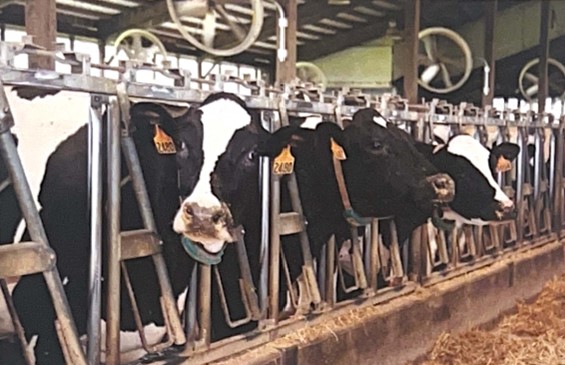
Cows at Barkeim Farm.